Introduction
The 2024 research campaign brought remarkable discoveries in the sacred zone of the ancient city of Histria. The team from the Dinu Theodorescu Archaeological Laboratory continued systematic excavations in the northern sector of the temple area, where new layers of votive deposits were identified.
Context of the Discovery
Histria’s sacred zone is well known for its stratigraphic complexity. Archaic levels, overlaid by Hellenistic and Roman constructions, provide a complete picture of the evolution of religious practices over nearly a millennium. The 2024 campaign focused on an area of approximately 80 m², located immediately adjacent to the sanctuary identified in previous campaigns.
Ceramic Materials
Among the most significant finds is an important group of ceramic fragments datable to the archaic period (7th–6th century BC). The pieces include fragments of Corinthian and Laconian import vessels, as well as local pottery in the Greek tradition. The presence of import vessels confirms the city’s commercial links with the major centres of the Greek world.
A fragment of a kylix with figural representations — identified as a product of an Attic workshop from the first half of the 5th century BC — represents one of the most valuable pieces recovered in this campaign. The partially preserved decoration depicts a symposion scene, frequently associated with votive contexts in Greek sanctuaries.
Coins and Metal Artefacts
In addition to ceramics, the team recovered six Histrian bronze coins, three of which are in good condition and allow precise dating to the 4th century BC. The coins display the characteristic typology of the Histrian mint — the eagle on dolphin on the obverse and the wheel on the reverse — confirmed by comparison with pieces in museum collections.
Also discovered were fragments of a decorative bronze appliqué and an iron spearhead, probably a votive offering. The state of preservation of the metal piece allows metallographic analysis, which will be carried out in the conservation laboratory.
Preliminary Interpretation
The assemblage of recovered materials suggests that this area functioned as a space for votive deposits from the early archaic period. The diversity of the pieces — luxury import ceramics, coins, metal artefacts — indicates a sanctuary frequented by diverse social strata of the Histrian population.
Research will continue in the 2025 campaign, with a focus on fully delimiting the sanctuary and identifying any associated architectural structures.
Acknowledgements
The team thanks the student volunteers who participated in the 2024 campaign, as well as the National History and Archaeological Museum in Constanța for their logistical support.
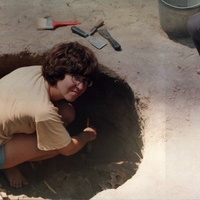
Alexandra Târlea
University Lecturer — Histria Research Lead
Lect. univ. dr. Alexandra Târlea coordinates research in the sacred zone of Histria, focusing on temples and altars from the archaic and classical periods. Her doctorate, obtained at the University of Bucharest, made essential contributions to understanding the religious topography of the city.